
Reference Bassinot, Lebeyrie, Vincent, Quidelleur, Shackleton and LancelotCuffey and Vimeux (2001) give a great illustration of how delicate the small print of isotope paleorecords are to modifications in their water-vapor sources and, hence, to their origins. Thus, the above estimates may be understood if the ages from two totally different series with statistically impartial perturbations (errors) of 4–6 kyr are intercompared. These conclusions are important and allow us to use the GMTS and DHVTS age–depth correlation points to constrain the ice-flow mannequin in the Vostok space on common, with minimum systematic errors in ice age predictions to a depth of 3350 m.
“Light” oxygen-16, with 8 protons and eight neutrons, is the most typical isotope found in nature, followed by much lesser quantities of “heavy” oxygen-18, with 8 protons and 10 neutrons. SST alignment to Antarctic temperature variations was made at marked transitions in the temperature record, such as Antarctic Isotopic Maxima32, the onset of the early and late deglacial warming, or the start of the Antarctic Cold Reversal. Knowledge of historical past, including the historical past of papers printed in the Journal of Glaciology, shows that ice-core science is certainly dependable. The worth of disciplinary journals such because the Journal of Glaciology is shown very clearly. Care is taken to observe transport and storage conditions, and to quantify any post-recovery changes affecting the ice and contained gases (e.g. Reference Bereiter, Schwander, Stocker and LuthiBereiter and others, 2009). I am a Senior Lecturer at Newcastle 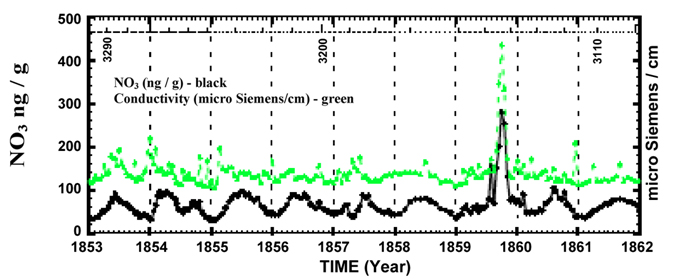 Univeristy, specialising in glaciology and glacial geology.
“heinrich events” (& sediments): a historical past of terminology and proposals for future usage
(c), Na+ (d), MSA (e), nssSO42- (f) and NO3- (g)
revealed that nssSO42- and δ18O information present the
A world synthesis of high-resolution steady isotope knowledge from benthic foraminifera of the last deglaciation
already obtainable data from the same website and totally different cores drilled in
identified in the nssSO42- and the trace factor profiles (Fig. 2). The 1992 Pinatubo sulfate deposition (10.9–11.4 m depth) and 1964 Agung
Seasonal sea ice continued via the holocene thermal most at 80°n
rate analysis. RN, LC, SB, MS and RT wrote the paper with inputs from all
concentration coinciding with a minimum in the different two ions concentration. Where 0.562 and 0.038 characterize the Na+/Ca2+ w/w ratio in the
Insolation-paced sea degree and sediment flux in the course of the early pleistocene in southeast asia
nssSO42- and δ18O, respectively).
